
Here’s Why Mortgage Rates Are What They Are Right Now

If you have been waiting for mortgage rates to drop significantly before buying a home, you may be wondering how much longer you should wait.
Mortgage rates can feel unpredictable. One week, you hear that rates could come down. The next, economic news suggests they could stay higher for longer.
Instead of trying to predict the next headline, it can help to understand what actually influences mortgage rates in the first place.
One important piece of the puzzle is something called the mortgage spread. Understanding it may give you a clearer perspective on where rates stand today.
The Pattern That Has Held for More Than 50 Years
Mortgage rates do not move completely on their own.
They tend to follow the 10-year U.S. Treasury yield, which is influenced by investor expectations about inflation, economic growth, and broader financial conditions. The relationship is not exact, and mortgage rates are affected by other factors too, but these two measures have historically moved in a similar direction.
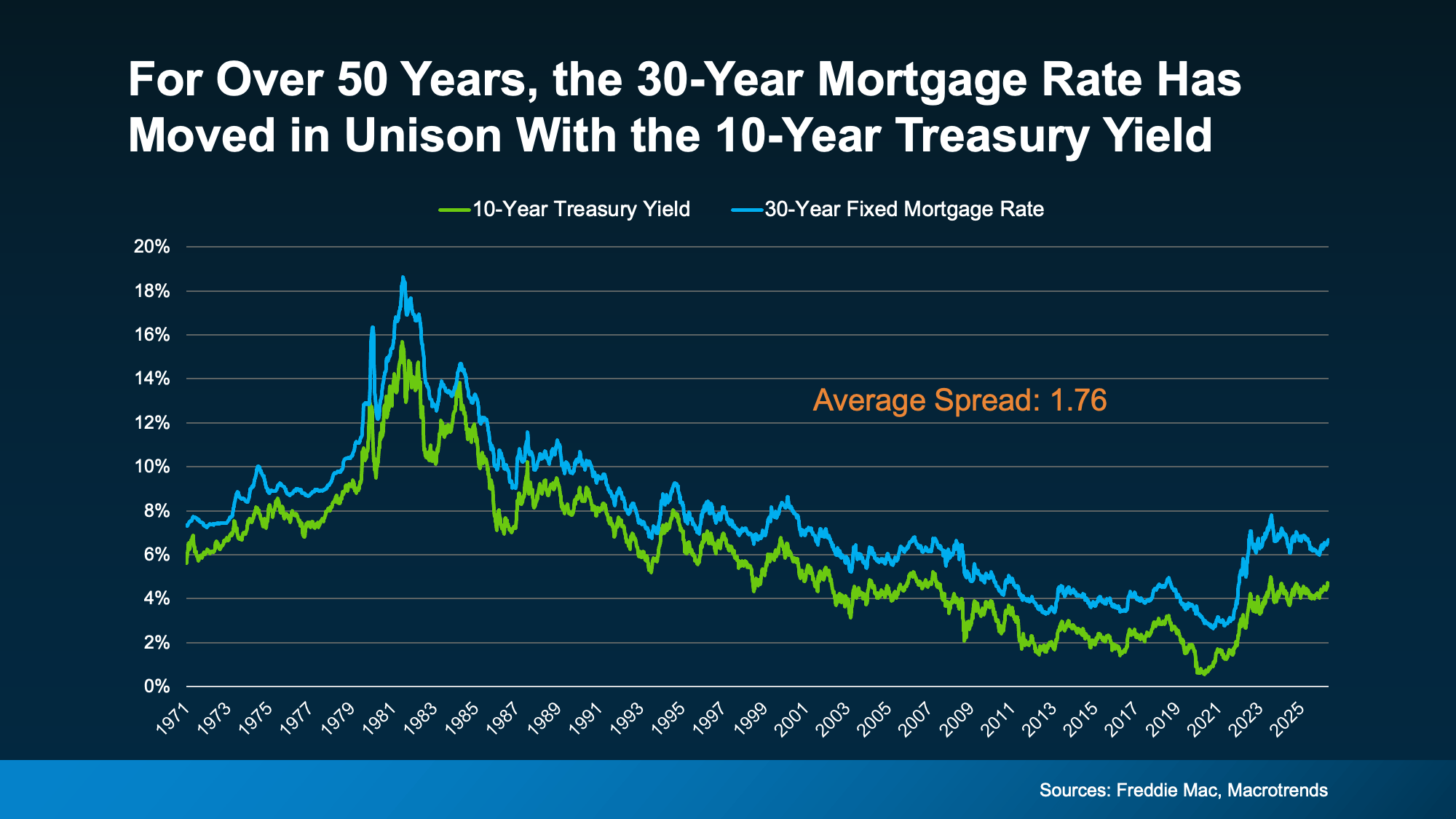
The difference between the 10-year Treasury yield and the average mortgage rate is known as the mortgage spread.
Think of the spread as the additional amount added to the Treasury yield to help determine the mortgage rate a borrower may receive.
Historically, that spread has averaged around 1.76 percentage points.
When the spread gets wider, mortgage rates tend to be higher than the Treasury yield alone would suggest. When the spread narrows, mortgage rates can move closer to the Treasury yield.
Why the Mortgage Spread Matters Right Now
A few years ago, the mortgage spread became unusually wide as uncertainty in the economy and financial markets increased.
In 2023, the spread reached approximately 3.19 percentage points, well above its long-term average.
Since then, the spread has narrowed and is now around 2.01 percentage points, much closer to the historical norm of 1.76%.
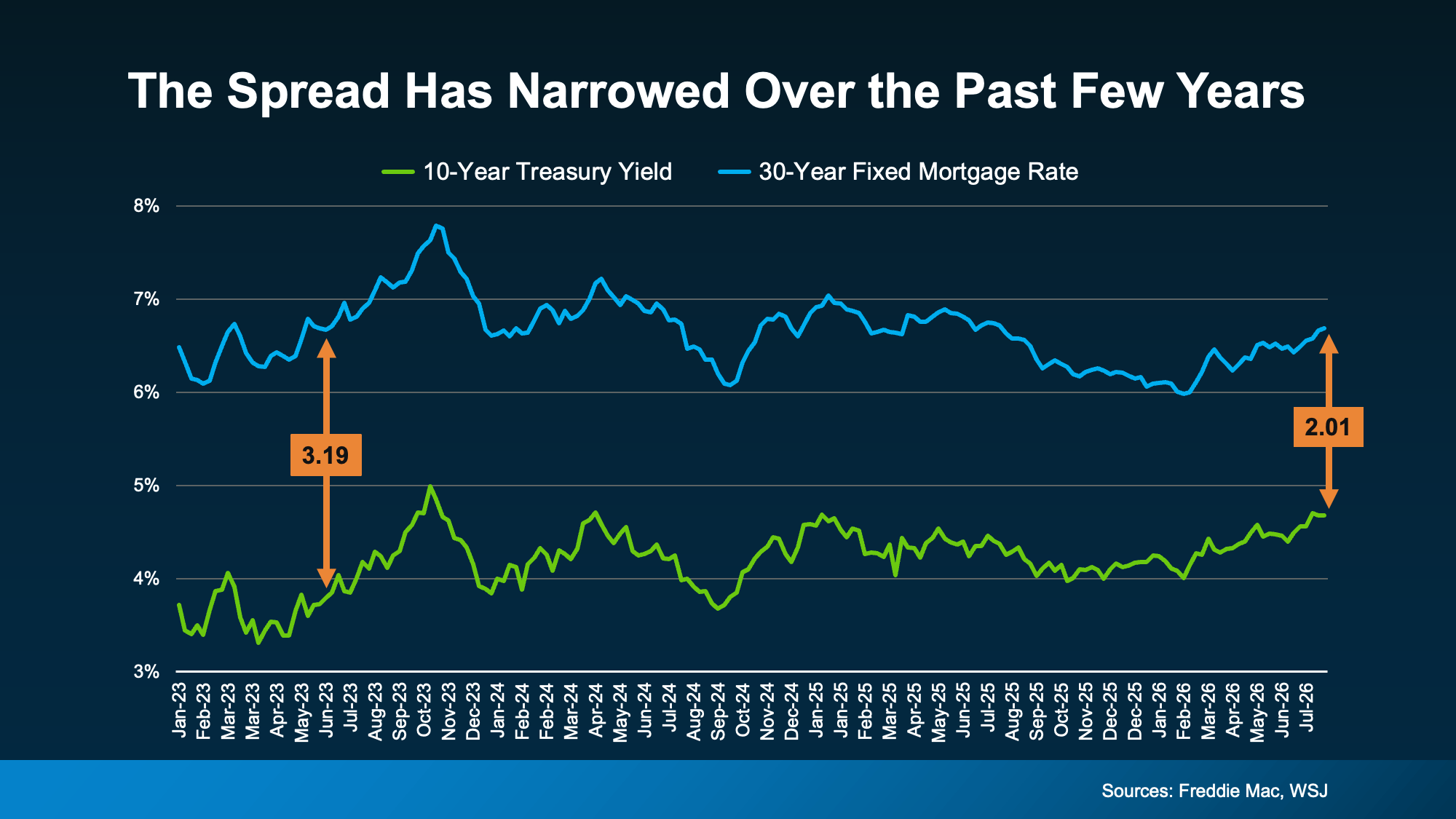
That matters because a narrower spread has already helped keep mortgage rates lower than they might have been if the unusually wide spread from 2023 had remained in place.
But there is another side to that story.
Because the spread is now much closer to normal, there may be less room for mortgage rates to fall simply because of further spread improvement.
In other words, the same improvement that has helped prevent rates from being even higher is also one reason buyers should not assume rates will suddenly fall dramatically from here.
Why Mortgage Rates Aren’t Even Higher Right Now
A simple way to understand this is:
Mortgage Rate ≈ 10-Year Treasury Yield + Mortgage Spread
For example, using the figures from the current national analysis, a 10-year Treasury yield of 4.68% combined with different spread scenarios could produce very different mortgage rates.
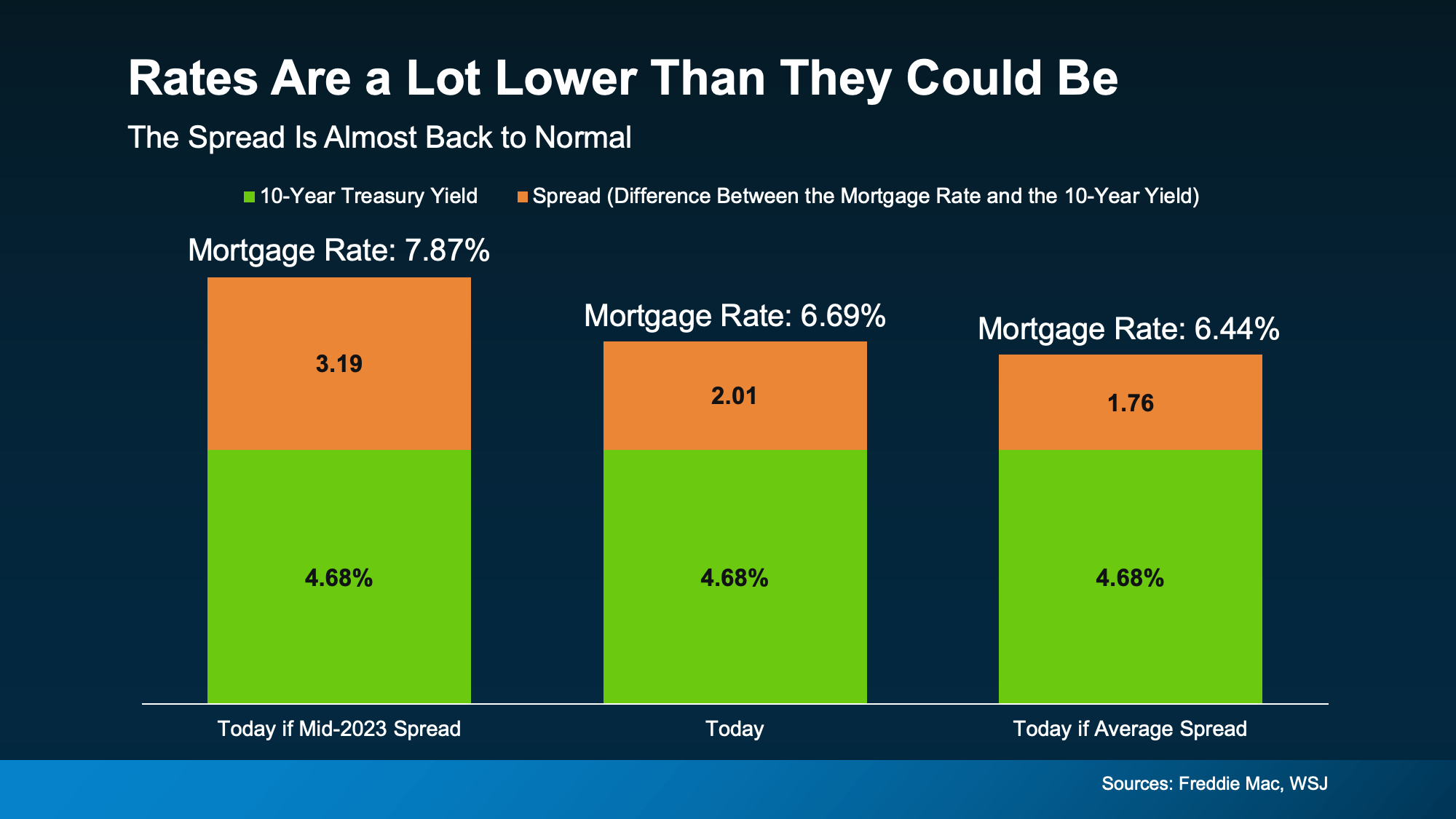
If the spread were still as wide as it was in 2023, mortgage rates could be approaching 8%.
With the spread closer to its current level, the example rate is around 6.69%.
If the spread were exactly at its long-term average, the example would be closer to 6.5%.
This illustrates an important point: the mortgage spread has already done much of the work it can realistically do to bring rates down.
That does not mean mortgage rates cannot change. They can.
Rates may move as inflation, broader economic conditions, Treasury yields, financial markets, and Federal Reserve policy change. Mortgage rates are influenced by several market factors and are not directly tied to a single Federal Reserve decision.
It simply means that waiting for the spread alone to create a dramatic drop may not be the most realistic strategy.
What This Means for Buyers in Southeast Georgia
If you are considering buying a home in Southeast Georgia, national mortgage rates are only one part of the affordability picture.
Your total monthly housing cost can depend on factors such as:
The purchase price
Your down payment
Your loan type
Your interest rate
Property taxes
Homeowners insurance
HOA fees, when applicable
Your individual financial situation
That is why the affordability conversation should not stop at one question: “What is the interest rate?”
A more helpful question is:
“What would the total monthly payment look like for the home I am considering, and does that payment fit my budget?”
For example, a different purchase price, down payment amount, seller concession, builder incentive, or loan structure could affect the monthly payment more than a buyer expects.
A qualified lender can calculate those numbers based on your individual financial situation. A local real estate professional can help you understand which homes are available in the price range you are comfortable considering in Hinesville, Fort Stewart, Richmond Hill, Midway, Ludowici, Jesup, Savannah, and surrounding Southeast Georgia communities.
Should You Wait for Rates To Drop?
There is no universal answer.
If you are financially comfortable waiting, there is nothing wrong with taking your time and watching the market.
But if you are waiting only because you expect mortgage rates to suddenly fall several percentage points, it may be worth reconsidering that assumption.
Rates could move lower. They could also remain relatively steady or move higher.
No one can predict the exact path with certainty.
What you can do is understand your financing options, review your monthly payment, and make a decision based on your timeline, budget, and goals instead of trying to perfectly time the market.
Bottom Line
Mortgage rates are not random, and they are not determined by just one factor.
The 10-year Treasury yield and the mortgage spread are two important parts of the picture. The good news is that the mortgage spread has narrowed significantly from the unusually high levels seen in 2023, helping keep mortgage rates from being even higher.
However, because the spread is now closer to its historical average, it may not have much more room to improve dramatically.
If you are considering buying in Southeast Georgia, do not let the rate alone determine whether you should move forward. Look at the full picture: the home price, your financing options, your expected monthly payment, and your personal timeline.
The Shanken Team can help you understand what is available in today’s local market and create a strategy that fits your real estate goals.