
Is There a Data Center Coming to Liberty County?
Not one under construction right now, but the conversation has already reached the county. A few years ago, Liberty County fielded an inquiry about a data center near Riceboro, though it never moved past early talks. Jeff Ricketson, executive director of the Liberty Consolidated Planning Commission, has pointed to the county's water restrictions as one reason large, water-intensive facilities like data centers haven't found an easy fit here so far.
Neighboring counties are having the same conversation. Bryan County, home to Richmond Hill, and Bulloch County have both fielded inquiries without a formal proposal on the table, and Bulloch enacted a 90-day moratorium earlier this year to study zoning rules before any project moves forward. Effingham County has had several inquiries of its own. None of that means a facility is coming to your street, but it does mean this is no longer a hypothetical conversation for Liberty County and its neighbors.
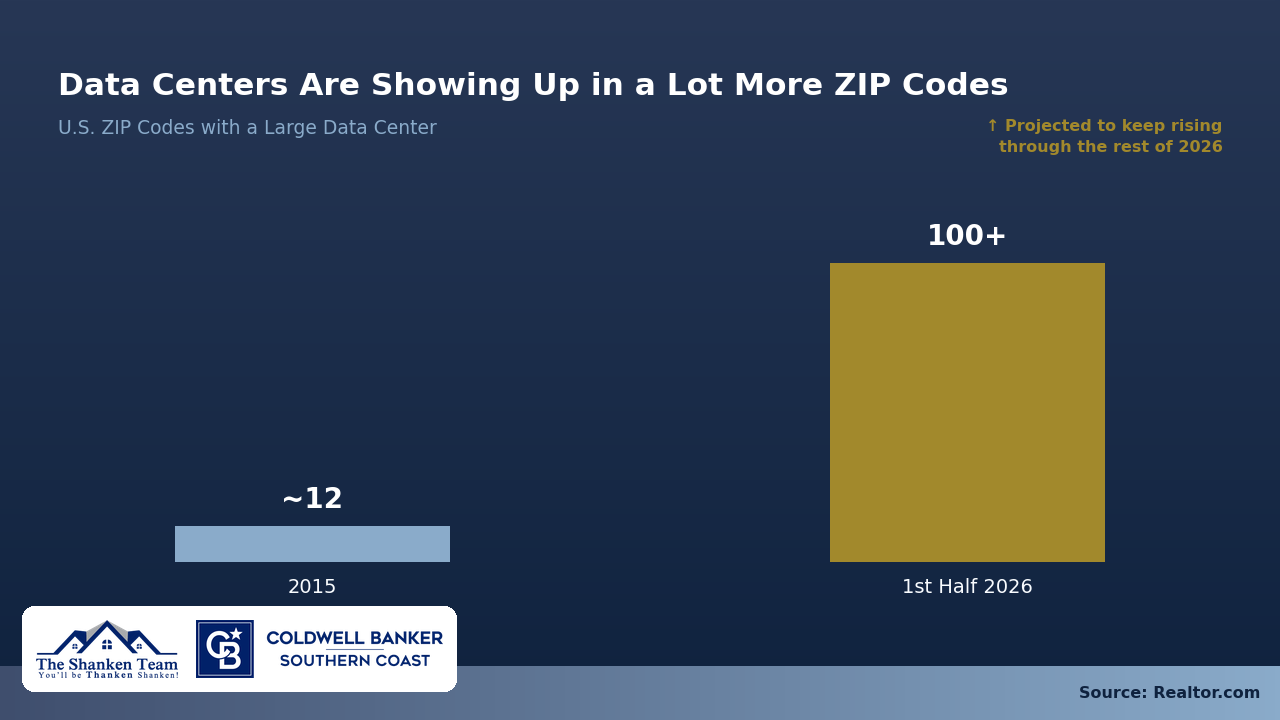
Nationally, the growth is real. Back in 2015, only about a dozen ZIP codes across the country had a large data center. By the first half of 2026, that had climbed past 100, and it's expected to keep climbing through the rest of the year, according to Realtor.com. Georgia is one of the ten states researchers are watching most closely for future growth, alongside Texas, Virginia, Pennsylvania, and others.
Georgia's Growing Data Center Footprint
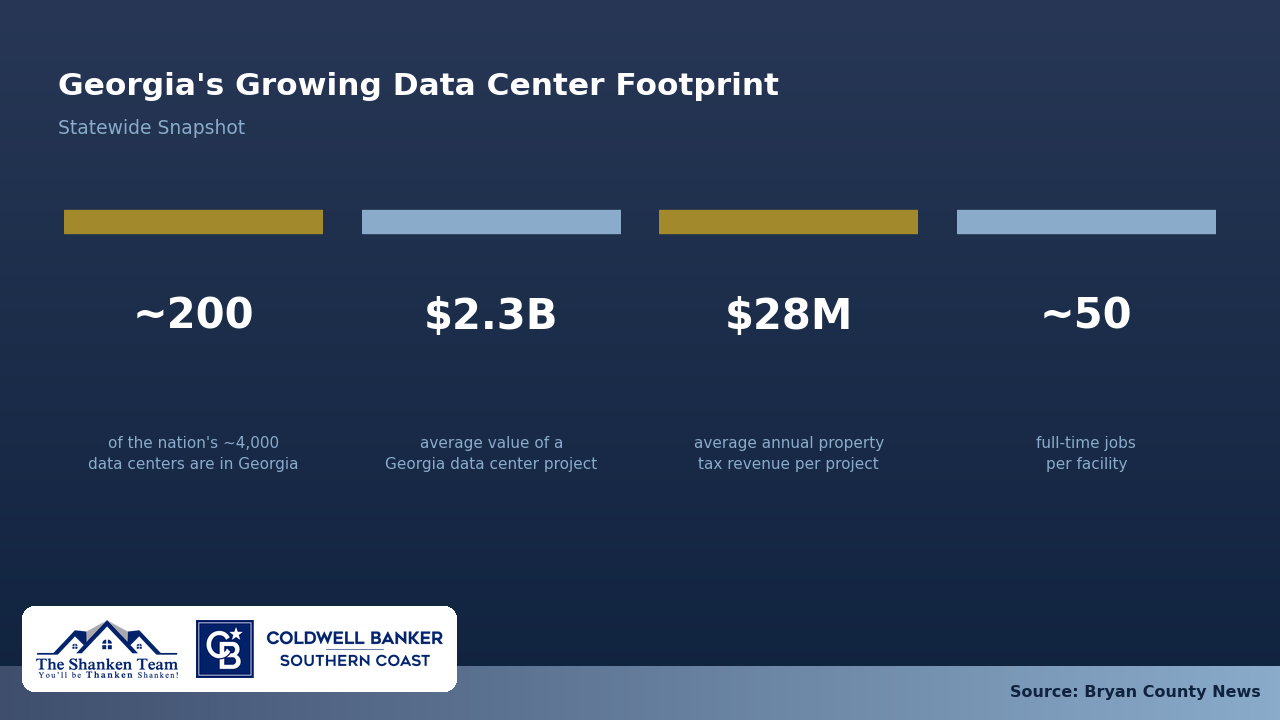
Georgia already has roughly 200 of the country's estimated 4,000 data centers, and the economics behind each one are substantial. A typical Georgia project carries an average value of $2.3 billion, generates around $28 million a year in property tax revenue, and creates about 50 full-time jobs, according to reporting by Bryan County News. That tax revenue and job creation is the kind of growth story county leaders across the region are weighing against the tradeoffs below.
Do Data Centers Affect Home Values?
So far, the data says no, not automatically. Researchers who compared communities with large data centers to similar communities without them found that home values in data center ZIP codes generally tracked their matched communities, with no statistically meaningful gains or losses, and only a modest, temporary bump in listing prices around a facility's opening.
That doesn't mean every property responds the same way. Proximity, the surrounding development, and the specific facility all matter. But for a typical Liberty County homeowner or buyer, there's no evidence in the data right now that a nearby data center automatically moves your home's value up or down.
What Living Near a Data Center Could Mean Locally
Community discussions in Bryan, Bulloch, and Effingham counties have surfaced the same set of tradeoffs real estate agents nationally are seeing.
On the plus side, a data center project can bring substantial property tax revenue a county can put toward roads, schools, and other improvements, along with construction jobs and the ongoing employment the facility itself creates. Infrastructure upgrades, like new roads, power lines, and fiber, often come along with a project of that size.
On the flip side, these are large facilities. Transmission lines, substations, and construction can change how an area looks and feels, and cooling equipment, generators, and truck traffic can be noticeable depending on how close you are. Community members in neighboring counties have also raised questions about water use, since many data centers rely on large volumes of water for cooling, which is part of why Liberty County's own water restrictions have kept the county less attractive to these projects so far.
Will a Data Center Raise Your Georgia Power Bill?
Georgia Power says no. The utility states that large energy users like data centers pay upfront for the local infrastructure they need and commit to long-term contracts, so residential customers aren't subsidizing that growth. Under rules the Georgia Public Service Commission approved alongside a nearly 10-gigawatt generation expansion, about 80% of it earmarked for data centers, large users are required to cover the full cost of serving them.
Georgia Power projects that structure will actually work in residents' favor, estimating it could add up to roughly $102 a year in savings for a typical residential customer using 1,000 kilowatt-hours a month once the next base rate case is filed in 2028. That's Georgia Power's own projection, and like any utility forecast it's worth watching as the rate case actually plays out, but it's a very different starting point than the vague "rates could rise" concern you'll see in national coverage of this topic.
What Buyers and Sellers in Hinesville Should Do
If you're buying, ask what's already proposed or under discussion near a home you're considering, whether that's in Liberty, Bryan, Bulloch, or Effingham County. The Liberty Consolidated Planning Commission and your county's planning office are good first calls if you want to know what's on file for a specific area. If you're relocating through Fort Stewart on a PCS timeline, it's one more thing worth a quick check alongside school zones and commute times.
If you're selling, don't assume a data center rumor or a nearby inquiry automatically hurts your home's value, the data doesn't support that. But buyers may ask, so knowing the facts, what's actually been proposed, where it stands, and what Georgia Power's own rate protections say, can help you answer those questions with confidence instead of guesswork.
Bottom Line
Data centers are a real, growing part of Georgia's economic picture, and Liberty County and its neighbors are already part of that conversation. Have questions about a specific property or a project you've heard about nearby? Let's talk through what it could mean for your home or your next move.
FAQ
Is there a data center in or near Hinesville, GA? Not currently under construction. Liberty County fielded one inquiry near Riceboro a few years ago that didn't move forward, and neighboring Bryan, Bulloch, and Effingham counties have had similar early-stage inquiries without formal proposals in place.
Will a data center raise my electric bill in Georgia? Georgia Power says no. Under state-approved rules, large energy users like data centers pay the full cost of the infrastructure and power they use, and the utility projects the added revenue could save a typical residential customer around $102 a year once its next rate case is filed in 2028.
Do data centers lower nearby home values? No consistent evidence of that so far. Research comparing communities with large data centers to similar communities without them found no statistically meaningful difference in home values, just a modest, temporary bump in listing prices around a facility's opening.